Ask a room of family entertainment center (FEC) owners where their money comes from, and the newest investors will say one word: machines. The operators who survive their fifth year give a different answer. Gameplay is only one of six FEC revenue streams — and in a well-run venue it may account for less than a third of total revenue.
The distinction matters more in 2026 than ever. The global family and indoor entertainment market is growing at a CAGR of more than 11% through 2026 (based on Stratview Research data), which means more competition in every growing city. Venues that rely on gameplay alone are competing on machine count. Venues that build a multi-stream FEC business model compete on dwell time, repeat visits, and spend per guest — and they consistently out-earn their single-stream neighbors.
This guide breaks down the six revenue streams of a modern FEC, what margin each one carries, realistic revenue benchmarks, and five practical tactics to raise revenue per visitor — whether you are planning a new venue or upgrading an existing one.
The 6 Core FEC Revenue Streams
A modern family entertainment center earns from six distinct streams. Each has its own margin profile, staffing cost, and role in the customer journey:

| Revenue Stream | % of Total Revenue | Typical Margin | Key Driver |
|---|---|---|---|
| Gameplay (cards, coins, tokens) | 25–40% | 50–70% | Machine mix + dwell time |
| Food & Beverage | 15–25% | 60–80% | Dining zone visibility, dwell time |
| Birthday Parties | 10–20% | 50–70% | Party rooms, weekend programming |
| Memberships & Passes | 5–15% | 80%+ | Recurring revenue, retention |
| Group Events & Bookings | 5–10% | 40–60% | Corporate, school, after-hours events |
| Retail & Merchandise | 3–8% | 60–80% | Prize overflow, branded toys, souvenirs |
Two things stand out in this table. First, gameplay — the stream most first-time investors fixate on — carries the lowest margin of the profitable streams once prize costs are deducted. Second, the highest-margin streams (memberships at 80%+, F&B at 60–80%) barely exist in a poorly planned venue. That is the whole argument for designing your family entertainment center profit margins on day one instead of discovering them later.
Stream 1: Gameplay — The Traffic Engine, Not the Whole Business
Gameplay is the foundation of every FEC. It is what gets families through the door, and it is the stream most directly controlled by your equipment choices.
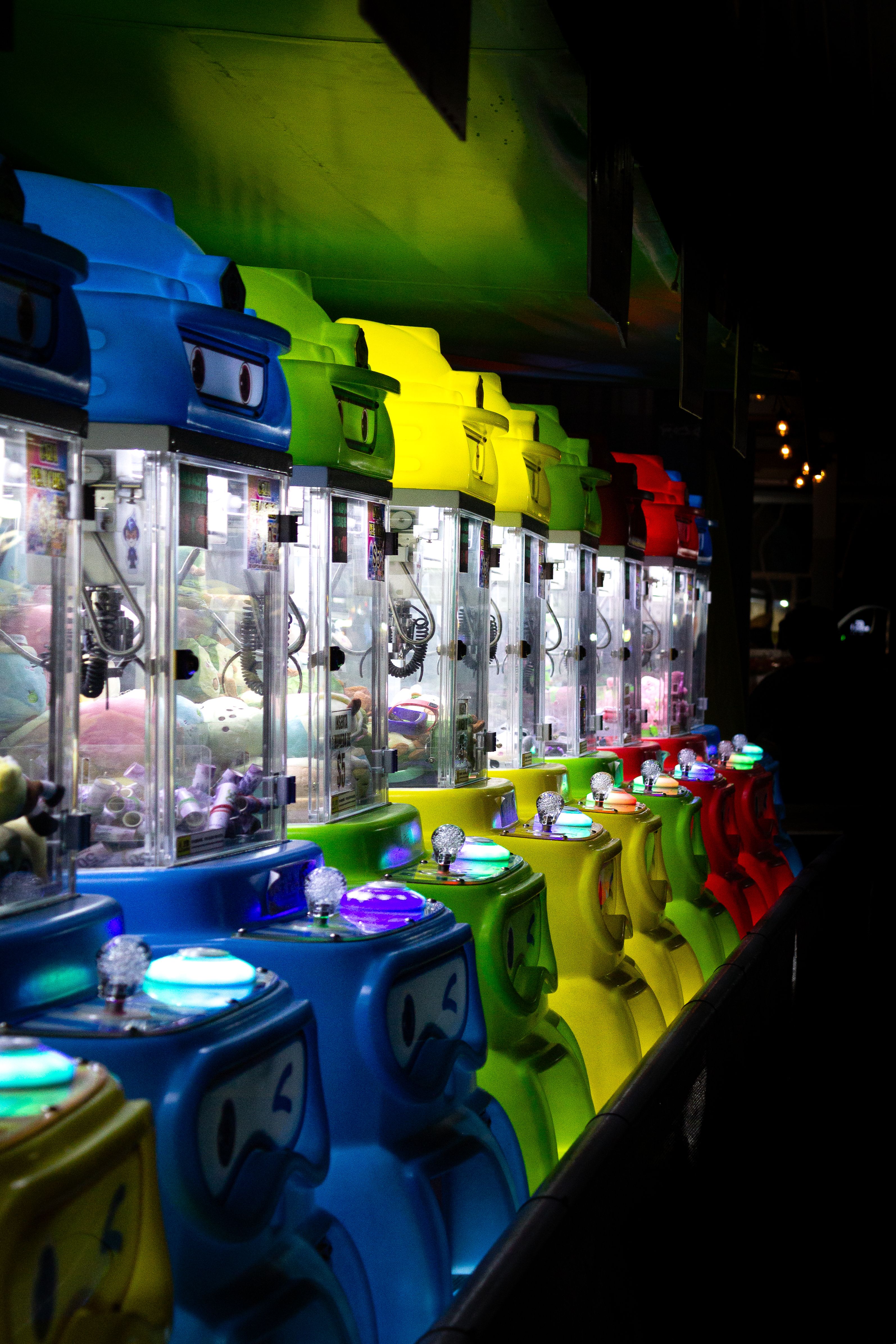
The economics look like this: a well-placed commercial claw machine in a busy location commonly grosses $40–$80 per day, with strong destination locations exceeding $100 (industry-average estimates). After prize costs of roughly 20–35% of revenue, your effective gameplay margin lands at 50–70%. Redemption and prize games, sports machines, and racing simulators follow the same pattern at different price points per play.
Three decisions move gameplay revenue more than any other:
- Machine mix. A balanced fleet — claw machines for volume, redemption games for repeat play, racing and sports machines for high spend-per-play — outperforms any single category. Venues built around one machine type underperform diversified fleets by 30–50% (based on industry FEC planning references).
- Dwell time. Every extra 15 minutes a family stays typically converts to another round of plays. Layout, seating, and F&B placement all feed this number.
- Cashless card systems. Tap-and-play card systems remove friction, raise average spend per visit, and — critically for the rest of this article — give you the infrastructure to sell bundles, parties, and memberships from one account balance.
The strategic point: treat gameplay as the engine that brings people in, and let the other five streams monetize the visit. That mindset is what separates an arcade from an FEC.
Stream 2: Food & Beverage — The Highest-Margin Habit Builder
F&B contributes 15–25% of revenue at a 60–80% margin in a typical FEC — and in barcade-style venues it can exceed 30% of revenue. No other stream rewards dwell time so directly: families who eat lunch at your venue stay for the afternoon session, and afternoon sessions are where gameplay, retail, and impulse plays stack up.
You do not need a full restaurant kitchen to capture this stream. The common progression is:
- Vending and snack walls — near-zero staffing, placed beside the redemption counter.
- Café counter — coffee, drinks, and grab-and-go items for parents; the single strongest dwell-time lever in family-focused venues.
- Full F&B zone — pizza, wings, and sharing platters, positioned so waiting families can see (and hear) the anchor machines.
Placement matters as much as menu. Impulse machines — capsule dispensers and small prize games — belong near the F&B queue, converting waiting time into plays. This is a layout decision, not a menu decision, and it is exactly what a planned three-zone floor layout is designed to capture.
Stream 3: Birthday Parties — The Weekend Profit Engine
Birthday parties are the highest-value transaction in most FECs. They contribute 10–20% of total revenue at 50–70% margins, and they arrive on a predictable schedule: weekend afternoons, exactly when walk-in traffic peaks.
Party and group bookings commonly start around $200 for a basic package and can exceed $1,000 for corporate and school event packages (based on FEC industry booking ranges). A single weekend party slot can out-earn a full day of walk-in gameplay — from one booking that also fills the venue with 8–15 young players who each bring spending parents.
What makes FEC birthday party revenue repeatable:
- Dedicated party rooms. Even one bookable room transforms your calendar. Privacy is what parents are paying for.
- Packaged pricing. Bundled packages (room + play credits + food + prize vouchers) raise perceived value and simplify the purchase decision for parents.
- Weekend programming. Parties anchor Saturday and Sunday; memberships (next section) fill weekdays. Together they smooth the weekly revenue curve.
- Capture and rebook. Every party guest list is a marketing database. Book the next birthday before the cake is cut.
Streams 4–6: Memberships, Group Events, and Retail
The remaining three streams are smaller individually — but they compound each other and stabilize month-to-month cash flow.
Memberships & passes (5–15% of revenue, 80%+ margin). Monthly play passes, family memberships, and prepaid bundles convert irregular visitors into regulars. Because the incremental cost of a member visit is nearly zero, membership is the highest-margin stream in the building. It also generates the visitor data that powers party upsells and event marketing.
Group events & bookings (5–10%, 40–60% margin). Corporate team-building, school reward trips, youth sports celebrations, and after-hours buyouts fill weekday troughs — often at minimum-spend thresholds that guarantee revenue before the doors open.
Retail & merchandise (3–8%, 60–80% margin). The most underused stream. Prize overflow — plush toys, capsules, and licensed merchandise — can be merchandised at a retail wall near the exit, converting redemption tickets into incremental purchases. Branded merchandise turns your venue’s mascot or logo into walking advertising.
How Much Revenue Does a Family Entertainment Center Make?
So what does this all add up to? How much revenue does a family entertainment center make in practice? Based on industry planning benchmarks, a 1,000 m² FEC with a planned three-zone layout typically achieves $1,200–$2,000 revenue per square meter annually — roughly 30% higher than an unplanned “machines against the wall” layout.
Applied to an illustrative 1,000 m² venue with a $800,000 total investment, the FEC ROI picture looks like this:
| Scenario | Annual Revenue | Operating Margin | Annual Profit | Payback |
|---|---|---|---|---|
| Conservative | $600,000 | 12% | $72,000 | ~11 years |
| Base Case | $1,000,000 | 20% | $200,000 | ~4 years |
| Optimistic | $1,500,000 | 25% | $375,000 | ~2.1 years |
These are illustrative scenarios, not guarantees — actual results depend on location, equipment mix, and operating discipline. But the pattern across the industry is consistent: most successful FECs reach operational break-even in 12–18 months and full FEC payback period of 2.5–4 years. The conservative scenario in the table is what a single-stream venue without parties, memberships, or planned layout slowly becomes. The difference between an 11-year payback and a 4-year payback is not luck — it is the six streams, working together.
5 Ways to Raise FEC Revenue Per Visitor
Understanding the streams is half the job. Here are the five tactics that most reliably raise spend per visit:
- Sell time bundles, not plays. Price cashless cards in timed or credit bundles ($20 / $50 / $100 tiers) with a bonus-credit gradient. Guests pre-spend, and unspent balances become pure margin.
- Program the party calendar. Publish party packages with three price tiers, and require a deposit. A bookable room plus packaged pricing routinely becomes 15%+ of revenue within the first year.
- Launch a founding membership. Even a simple monthly pass (unlimited weekday play + F&B discount) builds a recurring revenue base and a marketing list you own.
- Merchandise the exit. Place a prize-and-retail wall between the redemption counter and the door. Let guests convert leftover tickets and cash into merchandise — the fixture pays for itself in weeks, based on typical redemption-retail conversion.
- Run a weekday event calendar. Toddler mornings, student discounts, corporate happy-hour buyouts. Group bookings turn your slowest days into booked revenue with guaranteed minimums.
None of these tactics require new construction. All of them require that your equipment fleet and floor plan were designed with the six streams in mind — which is exactly the conversation worth having before you place an equipment order.
Frequently Asked Questions
What are the main FEC revenue streams?
A modern family entertainment center earns from six streams: gameplay (25–40% of revenue), food & beverage (15–25%), birthday parties (10–20%), memberships and passes (5–15%), group events and bookings (5–10%), and retail or merchandise (3–8%). Exact mix varies by venue concept and market.
How much revenue does a family entertainment center make per year?
Based on industry planning benchmarks, a 1,000 m² FEC with a planned layout typically generates $1,200–$2,000 per square meter annually — roughly $1.2M–$2M per year at that size. A small mall-based FEC may earn $150,000–$500,000, while large destination venues can exceed $2M. These are illustrative industry scenarios; actual results depend on location and management.
Which FEC revenue stream is the most profitable?
Memberships are the highest-margin stream (80%+) because member visits cost almost nothing to serve. F&B follows at 60–80% margin. Gameplay generates the largest volume but carries the lowest effective margin after prize costs (50–70%). The strongest venues combine all six streams rather than maximizing one.
How long does it take for an FEC to break even?
Most successful FECs reach operational break-even in 12–18 months and full payback in 2.5–4 years, based on industry averages. Venues with a diversified six-stream model and planned layout sit at the faster end; single-stream venues without parties or memberships often stretch far beyond that.
How do I increase revenue per visitor at my FEC?
The five highest-impact tactics: sell bundled card credits instead of single plays, package and pre-sell birthday parties, launch a membership program, merchandise the exit path with prize retail, and run weekday group events. All five raise spend per visit without expanding your floor space.
Do I need a cashless card system to run multiple revenue streams?
Strongly recommended. A cashless card system ties gameplay, F&B, and retail into one guest account, enables bundles and memberships, reduces coin-handling labor, and gives you spending data to optimize the mix. It has become the standard for multi-stream FEC operations in 2026.
Plan Your Revenue Streams Before You Buy Your Machines
The equipment you choose determines which of the six revenue streams your venue can actually run. JoyEngine supplies all six equipment categories a modern FEC needs — from one factory in Guangzhou:
✔ 6 machine categories, 46 models — build a balanced, multi-stream fleet from one supplier
✔ Free 3D layout design engineered around dwell time, party flow, and F&B placement
✔ Factory-direct pricing with flexible MOQ — pilot one venue, then scale
✔ CE certification, 12-month warranty, and lifetime technical support
Get a Free FEC Equipment Quote →
Browse the FEC Equipment Catalog →
JoyEngine Arcade Co., Ltd. — factory-direct arcade machine manufacturer in Panyu, Guangzhou, exporting to 80+ countries. Revenue figures in this article are industry-typical illustrative ranges, not guaranteed outcomes.