
Equipment is the single largest line item in a family entertainment center budget — typically 30–35% of total startup cost — and it is the one decision that shapes every revenue stream you can run afterward. Buy the right FEC equipment mix and the venue monetizes dwell time six different ways. Buy the wrong mix and you own a room full of machines that all appeal to the same thirty seconds of a customer’s visit.
This guide breaks down the real FEC equipment cost for 2026: the six machine categories every profitable venue needs, what each category costs per unit, how to split your floor space by venue size, and three ready-to-adapt equipment budget packages by scale.
Start With Your Venue Concept, Not the Machines
The most common equipment buying mistake is choosing machines before defining the concept. The same square meter supports very different businesses, and each concept pulls toward a different equipment list:
| Concept | Target Customer | Avg. Spend / Visit | Equipment Bias |
|---|---|---|---|
| Mall-based mini FEC | Families, kids | $10–$25 | Claw + capsule (passive, unattended) |
| Mid-size community FEC | Families, teens | $20–$45 | Balanced six-category mix |
| Large destination FEC | Multi-generational | $30–$80 | Anchor attractions (racing, VR) + full mix |
| Barcade / adult arcade | Adults 21+ | $25–$60 | Sports, racing, redemption + strong F&B |
| Resort / hotel FEC | Tourists, families | $15–$40 | Compact, high-turnover passive machines |
Write your concept in one sentence — “a 400 m² mall FEC serving families with children 4–12” — and every equipment decision that follows gets easier. The machine mix serves the concept; the concept never bends to accommodate a machine someone thought looked fun.
The 6 Equipment Categories Every FEC Needs
Modern FEC equipment falls into six functional categories. Here is what each does, what it costs, and what to check before buying.

1. Claw Machines — The Visual Anchor (20–30% of floor space)
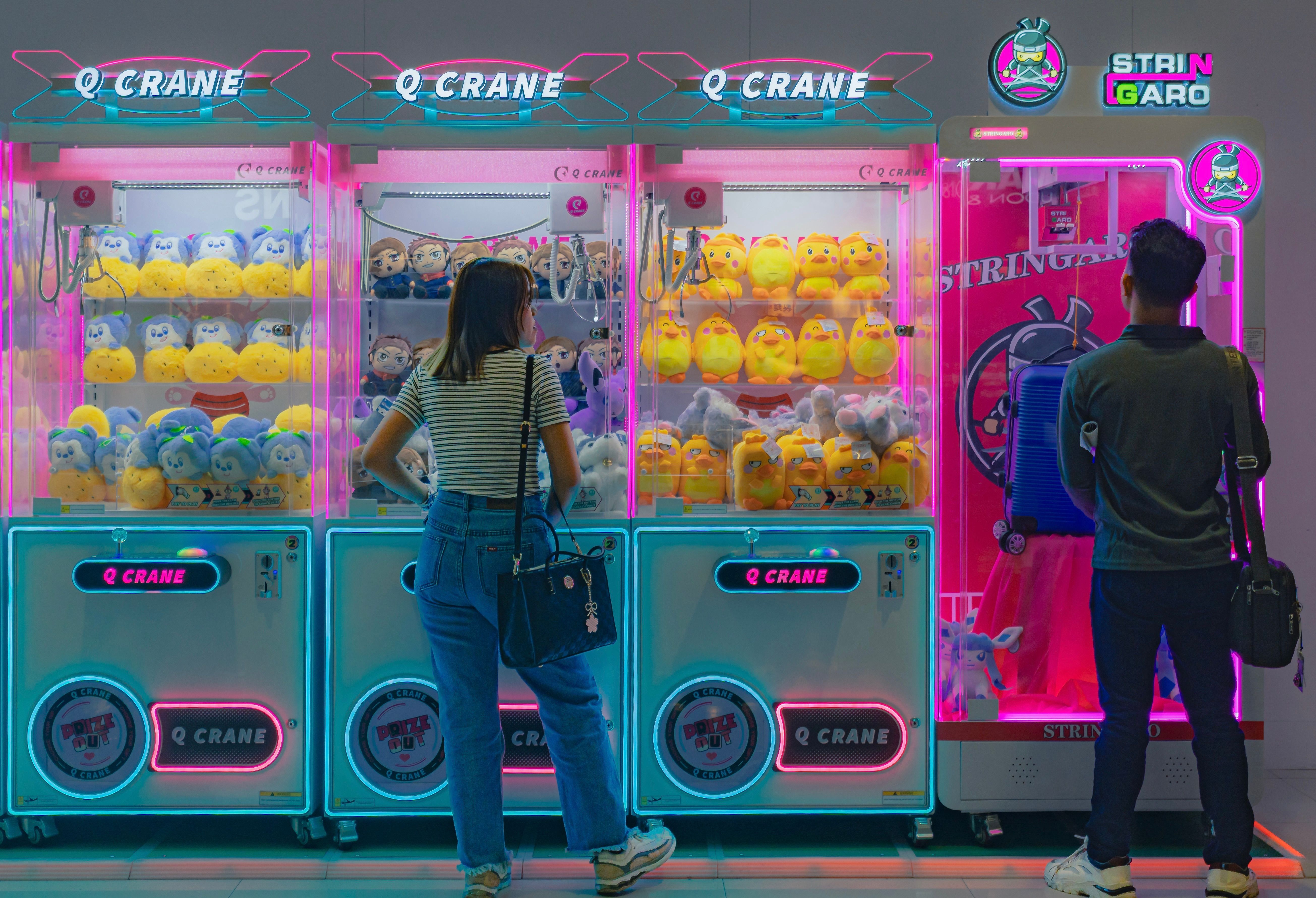
Claw machines are the workhorse of family-focused venues: high play frequency, low staffing (prize refills roughly once a week), and transparent cabinets that pull foot traffic from across a mall corridor. For most new FECs, this is the right first purchase.
- Per-machine investment: $800–$3,000
- What to check: adjustable claw strength (essential for payout control), tempered glass, metal or reinforced cabinet, CE certification, and cashless payment support
- Typical roles: entrance attraction (transparent LED models), family zones (double-player models), passive corners (compact units)
2. Redemption & Prize Games — The Repeat-Play Driver (10–15%)
Redemption games — coin pushers, scissor-cut prize machines, press-button prize machines, and ticket games — give players a reason to come back: the prize. They generate the longest dwell times of any category and pair naturally with a prize counter and retail wall.
- Per-machine investment: $1,500–$5,000
- What to check: ticket or card dispensing reliability, prize capacity, and durability of high-touch components
- Typical roles: anchor zone (large redemption), exit path (prize counter + retail wall)
3. Capsule & Gashapon Machines — The Zero-Staff Income (10–15%)
Capsule dispensers are the cleanest “set and forget” revenue in the building: no attendant, minimal power, almost no maintenance. They convert waiting time near F&B queues and checkout into sales, and they anchor children’s zones.
- Per-machine investment: $500–$2,000
- What to check: capsule capacity, anti-jam mechanism, lockable hoppers, and cabinet artwork quality (capsule machines sell what visitors can see)
- Typical roles: entrance window, F&B queue, exit path, kids’ zone
4. Racing Simulators — The Anchor Attraction (10–20%)
Racing simulators and motion machines carry the highest spend-per-play in a typical FEC, and linked multiplayer cabinets generate the social competition that teens and young adults post about. Destination and barcade concepts live or die on this category.
- Per-machine investment: $3,000–$10,000
- What to check: linked multiplayer support, motion platform build quality, spare parts availability for seats and screens
- Typical roles: center anchor zone, visible from the entrance
5. Sports & Skill Machines — The Revenue Workhorse (15–20%)
Basketball, boxing, air hockey, and other skill machines run short play cycles (60–90 seconds) with almost no consumables. Across FEC portfolios they consistently rank among the top revenue generators per square meter.
- Per-machine investment: $1,500–$4,000
- What to check: build strength for competitive adult use, sensor accuracy, and ball/puck consumption costs
- Typical roles: perimeter zones, barcade floors, group-event areas
6. Interactive Touch & VR — The Differentiator (5–10%)
Touch-screen interactives and VR experiences are the “wow factor.” They carry the highest unit cost and the fastest content obsolescence, so they should differentiate the venue — not carry it.
- Per-machine investment: $5,000–$25,000
- What to check: content update policy, hygiene and maintenance requirements, throughput (players per hour)
- Typical roles: destination FECs, premium positioning, social media moments
The FEC Equipment Mix Formula
So how much floor space should each category get? The answer scales with your concept — but the structure of the answer is remarkably stable across successful venues:

Three principles sit behind these numbers:
- Claw machines anchor the volume. They are the most forgiving category — low staffing, broad appeal, steady income — which is why they hold 22–30% of floor space in every concept.
- Racing and sports scale with ambition. A mini FEC can run on passive machines; a destination FEC needs anchor attractions that justify a longer drive.
- Always reserve 10–15% flexible space. New machines, seasonal themes, and prize refreshes keep a venue feeling new. Venues that fill 100% of their floor on opening day have nowhere to put next year’s best-seller.
A practical starting point for a mid-size community FEC: 25% claw, 18% sports, 15% racing, 12% redemption, 12% capsule, 8% interactive, 10% flexible rotation space.
FEC Equipment Packages by Budget
To make the FEC equipment cost concrete, here are three starter packages built from industry-typical per-machine prices. Treat them as planning baselines, not quotes — every venue’s final list depends on concept, market, and supplier terms.
Starter Package — Mini FEC (200–400 m²)
Budget: $40,000–$80,000 · 25–35 machines
| Category | Units | Budget Range |
|---|---|---|
| Claw machines | 12–16 | $14,000–$40,000 |
| Capsule / gashapon | 6–8 | $4,000–$14,000 |
| Sports & skill | 4–6 | $7,000–$22,000 |
| Redemption / prize | 3–4 | $5,000–$17,000 |
| Racing / anchor | 0–1 | $0–$8,000 |
Built for passive, unattended operation with minimal staff. The machine mix leans on claw + capsule volume, which is exactly what a mall mini-FEC concept needs.
Growth Package — Mid-Size Community FEC (500–1,200 m²)
Budget: $150,000–$350,000 · 40–70 machines
| Category | Units | Budget Range |
|---|---|---|
| Claw machines | 15–20 | $18,000–$55,000 |
| Redemption / prize | 8–12 | $14,000–$55,000 |
| Sports & skill | 6–10 | $10,000–$38,000 |
| Racing simulators | 4–6 | $14,000–$55,000 |
| Capsule / gashapon | 4–6 | $3,000–$11,000 |
| Interactive / VR | 2–3 | $12,000–$60,000 |
The balanced six-category fleet. This is the package where the three-zone layout (entrance attraction, center anchor, perimeter income) starts earning its keep, alongside party rooms and F&B.
Destination Package — Large FEC (1,500–3,000 m²)
Budget: $400,000–$800,000+ · 70–120+ machines
| Category | Units | Budget Range |
|---|---|---|
| Claw machines | 20–30 | $25,000–$80,000 |
| Redemption / prize | 12–18 | $20,000–$85,000 |
| Sports & skill | 10–15 | $17,000–$55,000 |
| Racing simulators | 8–12 | $30,000–$110,000 |
| Capsule / gashapon | 8–12 | $6,000–$22,000 |
| Interactive / VR | 4–6 | $25,000–$130,000 |
Anchor-heavy and diversified. At this scale, equipment is typically 30–35% of a $1M+ project — the rest goes to fit-out, F&B kitchen, party rooms, and pre-opening marketing.
6 Questions to Ask Before You Sign the Equipment Order
The supplier you choose determines your pricing, your downtime, and how easy the six-category mix is to build. Before committing to any FEC equipment supplier, get clear answers on:
- Certifications — Are CE, RoHS, and ISO 9001 certificates available per model, not just as marketing claims? EU-bound shipments without them risk customs holds.
- MOQ and scaling — Can you pilot with a smaller first order and scale to container volumes with the same supplier?
- Spare parts — Are wear parts (claws, motors, sensors, payment components) stocked, with typical delivery times under two weeks?
- Payment systems — Do the machines support coin, bill, and cashless card integration from day one?
- Export logistics — Does the factory handle export packaging, container loading plans, and destination-market documentation?
- Layout support — Will the supplier produce a 3D floor plan for your actual room dimensions before you pay? (JoyEngine does, free of charge.)
A factory-direct manufacturer with 5–6 categories under one roof simplifies every item on this list — one contact, one parts pipeline, one consistent build standard across the fleet.
Frequently Asked Questions
What equipment does an FEC need?
A profitable family entertainment center needs six equipment categories: claw machines (20–30% of floor space), redemption and prize games (10–15%), capsule and gashapon machines (10–15%), racing simulators (10–20%), sports and skill machines (15–20%), and interactive touch or VR attractions (5–10%), plus 10–15% flexible space for rotation.
How much does FEC equipment cost?
Equipment typically represents 30–35% of total FEC startup cost. Based on industry-typical per-machine prices, a mini FEC (200–400 m²) needs roughly $40,000–$80,000 of equipment, a mid-size community FEC (500–1,200 m²) $150,000–$350,000, and a large destination FEC $400,000–$800,000+.
How many machines do I need for a 1,000 m² FEC?
A 1,000 m² FEC typically runs 40–70 machines: 15–20 claw machines, 8–12 redemption or prize games, 6–10 sports machines, 4–6 racing simulators, 4–6 capsule dispensers, and 2–4 interactive or VR attractions. The exact count depends on your concept and how much floor space goes to F&B and party rooms.
What is the best machine mix for a new FEC?
Start with the “anchor + perimeter” structure: 2–4 racing or VR attractions as the center anchor, surrounded by 10–15 claw machines, 6–10 sports machines, and 4–6 redemption games, with capsule machines at the entrance, F&B queue, and exit. Keep 10–15% of the floor empty for rotation. Single-category venues underperform diversified fleets by 30–50%.
Should I buy claw machines or redemption games first?
For most new venues, claw machines first: they need no attendant, appeal to the widest audience, and generate steady income while you build party and event revenue. Redemption games come next once you have the staffing and prize counter to run them properly.
Where should I buy FEC equipment?
Buy factory-direct from a manufacturer rather than through resellers — you get lower pricing, direct technical support, verifiable certifications, and spare parts from the source. Look for a supplier offering all six equipment categories, flexible MOQ, free layout design, and documented export experience to your market.
Compare FEC Budget Packages With a Factory Team
JoyEngine manufactures all six FEC equipment categories in one factory in Panyu, Guangzhou — so your mix, your spare parts pipeline, and your build standard all come from a single source:
✔ 6 machine categories, 46 models — from transparent claw machines to linked racing simulators
✔ Free 3D floor plan design based on your room dimensions and target customer
✔ Factory-direct pricing, flexible MOQ — pilot one venue, then scale to container volumes
✔ CE / RoHS / ISO 9001 certified, 12-month warranty, 48-hour technical response, exports to 80+ countries
Request a Free Equipment Quote →
Get a Free 3D Layout Design →
JoyEngine Arcade Co., Ltd. — factory-direct FEC and arcade equipment manufacturer in Guangzhou, China. Per-machine price ranges in this guide are industry-typical estimates for planning purposes; request a formal quotation for project pricing.